Choosing an Aluminium Front Door in 2026 is no longer only about appearance. Global buyers now compare insulation, security, weather resistance, maintenance, and long-term value.
“Good aluminium doors succeed when design, drainage, thermal performance, and installation work together,” says Martin Hayes, an independent aluminium fenestration consultant. That principle sounds simple. It is not always simple in practice.
This guide examines the leading Aluminium Front Door types for homes, apartments, offices, and coastal properties. It considers thermally broken systems, slimline frames, pivot doors, glazed entrances, flush panels, and oversized configurations. Each type performs differently in cold climates, humid regions, dusty cities, and areas exposed to strong sunlight.
A premium finish can still fail when water drainage is poorly designed. A strong lock can also disappoint if the frame is fitted unevenly. These details are easy to miss in product photography.
Material thickness, powder-coating quality, glass specification, hinges, seals, and threshold design deserve close attention. Buyers should also confirm testing data, warranty terms, replacement-part access, and local installation experience. Standards vary between markets, so one certificate may not prove suitability everywhere.
There is no perfect door.
The best choice depends on the building, climate, budget, and daily use. Some buyers may prefer a dramatic pivot entrance, while others need a compact, thermally efficient door for a narrow hallway. This overview helps compare those trade-offs clearly, although real projects can still reveal unexpected limitations. That is why careful technical review matters before ordering, especially for international shipments and custom-sized openings.
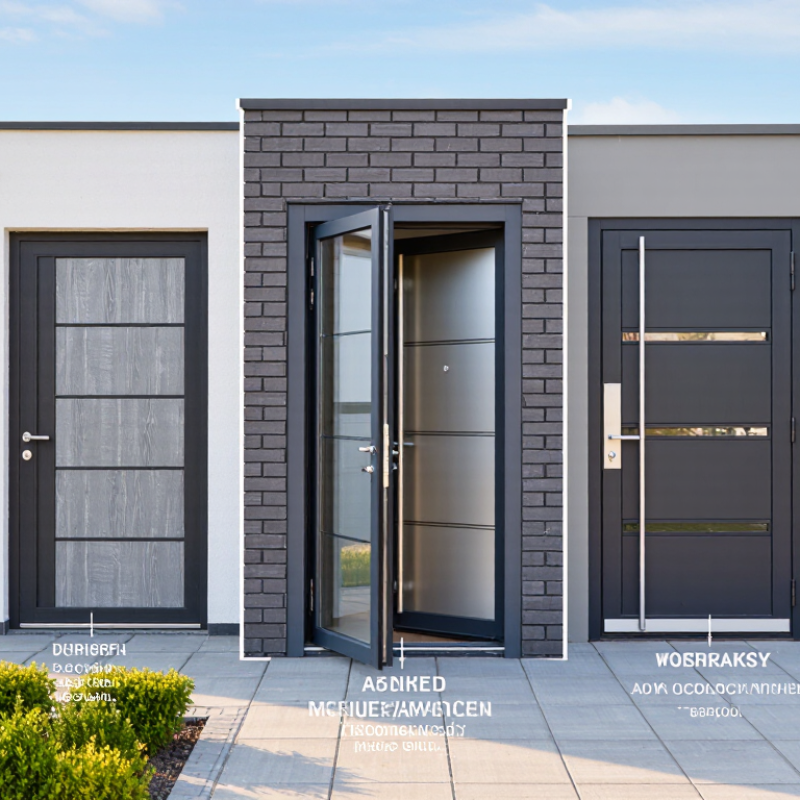
Aluminium front doors are built for strength, stability, and controlled maintenance. The material resists warping, insects, and everyday moisture better than many timber alternatives. It is also relatively light, making larger door panels easier to operate. However, aluminium conducts heat quickly. A quality door therefore needs a thermal break between its inner and outer sections. Without it, the frame may feel cold indoors and develop condensation in humid weather.
The structure usually includes an aluminium frame, insulated core, door leaf, glazing, seals, hinges, lock, and threshold. Multi-chamber profiles can improve insulation and reduce outside noise. Powder-coated surfaces offer consistent colour and protect against normal exposure. Coastal buyers should request suitable corrosion protection. It matters near salt air.
Glass selection affects comfort, security, and daylight. Double glazing is common, while low-emissivity glass can limit unwanted heat transfer. Warm-edge spacers may reduce condensation around the glass edge. Strong compression seals are essential, but they must be fitted evenly. A beautiful panel cannot correct a poorly aligned frame.
During site checks, I look closely at drainage paths and threshold height. Water needs a clear route away from the door. Hardware should match the panel weight and local climate. Buyers should also confirm dimensions, opening direction, wind exposure, and regional performance requirements before production. One practical weakness is often overlooked: dark finishes can become very hot under direct sun. Even a well-designed door may need shading or careful installation.
The chart compares representative thermal transmittance values for common aluminium front-door constructions. Lower U-values indicate better insulation. Thermally broken frames use a low-conductivity polyamide barrier between the interior and exterior aluminium sections, while double or triple glazing improves the overall door-system performance. Actual results vary according to frame depth, glazing, seals, size, installation, and local climate requirements.
Modern villas often suit minimalist flush aluminium doors. Their clean surfaces, concealed hardware, and dark powder coatings create a sharp architectural entrance. Large glazed panels can bring daylight into narrow hallways, but privacy glass may be necessary near busy streets. These doors usually need accurate wall measurements and careful thermal-break specifications.
Traditional houses can benefit from panelled aluminium doors with wood-effect finishes. They provide familiar proportions without the maintenance of timber. For apartments and compact townhouses, a single framed-glass door feels lighter and improves visibility. Wide double doors work well for luxury homes, yet they require stronger hinges, more clearance, and precise alignment. Pivot doors create a dramatic entrance, although their installation can be less forgiving. I would not choose one only for appearance.
2026 Best Aluminium Front Door Types for Global Buyers
How to Compare Door Security, Insulation, Glazing, and Durability
Aluminium front doors differ sharply in security, insulation, glazing, and service life. A secure door starts with the complete system, not the panel alone. Check the cylinder, multipoint lock, hinges, frame anchors, and tested resistance class. EN 1627 classifies pedestrian doors from RC1 to RC6, but certification must cover the assembled door. A strong lock cannot correct weak installation.
Insulation needs measurable evidence. Compare U-values, thermal breaks, air leakage, and threshold design. Lower U-values generally indicate better heat retention. The U.S. Department of Energy reports that windows can cause 25–30% of residential heating and cooling energy use. Glazed doors deserve similar attention. Choose low-emissivity double or triple glazing where climate and budget justify it. The IEA’s 2023 buildings report states that buildings consume about 30% of global final energy. Small thermal gaps matter. Yet triple glazing is not automatically better; poor frames or incorrect installation can waste its benefit. This is an easy detail to underestimate.
Tips: Request whole-door test reports, not isolated component claims. Ask for air, water, wind, and thermal results. Inspect drainage holes and gasket compression. For coastal homes, specify corrosion-resistant finishes and review salt-spray testing. For busy entrances, confirm hinge-cycle data and replacement-part availability. Aluminium resists warping, but damaged coatings can still expose vulnerable areas. Ratings help, imperfectly. Local installers may also interpret standards differently, so verify the certificate and installation method before ordering.
| Aluminium Front Door Type | Typical Construction | Thermal Performance Typical Door U-Value |
Security Potential | Glazing Options | Acoustic Performance | Weather Resistance | Expected Service Life | Best Application |
|---|---|---|---|---|---|---|---|---|
| Insulated Aluminium Panel Door | Thermally broken aluminium frame with a multi-layer insulated opaque panel, perimeter seals, and a reinforced lock zone. |
Approx. 0.7–1.2 W/m²K Usually the strongest insulation option because the opaque panel has limited thermal bridging and no large glass area. |
Commonly configurable to RC2 and, with suitable hardware and testing, RC3 under EN 1627. | Usually no glazing, or a small insulated vision panel using laminated or security glass. | Typically about 34–42 dB, depending on the panel, seals, threshold, and installation. | Good resistance when fitted with compression seals, a reliable drainage system, and a correctly designed threshold. Look for tested air, water, and wind classifications. | Approximately 25–40 years with proper adjustment, cleaning, and seal replacement. | Cold climates, security-focused entrances, apartments, and energy-efficient homes. |
| Part-Glazed Aluminium Panel Door | Insulated aluminium door leaf with one or more glazed sections integrated into an insulated panel. |
Approx. 0.9–1.5 W/m²K Performance is affected by the size of the glass area, spacer, frame, and edge detailing. |
Normally suitable for RC2 when combined with a multi-point lock, reinforced hinges, and safety glazing. | Double or triple insulating glass; laminated inner pane recommended where impact resistance and safer breakage are priorities. | Typically about 32–40 dB; laminated acoustic glass can improve sound reduction. | Good when the glazed panel, gaskets, drainage, and sill are tested as a complete door assembly. | Approximately 25–40 years; glass seals and hardware may require earlier maintenance. | Residential entrances requiring daylight while retaining a relatively solid appearance. |
| Full-Glazed Aluminium Entrance Door | Thermally broken aluminium perimeter frame with a large double- or triple-glazed insulated glass unit. |
Approx. 1.0–1.8 W/m²K The final result depends heavily on glazing ratio, spacer technology, frame depth, and threshold design. |
Can reach RC2 with tested security glazing, a reinforced frame, anti-lift hardware, and a multi-point locking system. | Double or triple insulating glass; laminated safety glass, impact-resistant glass, or privacy glass may be selected according to local requirements. | Typically about 30–38 dB; laminated glass and asymmetrical glass makeups can provide better acoustic control. | Requires careful attention to glass weight, drainage, seal compression, and threshold detailing. Large glazed areas may increase solar gain. | Approximately 20–35 years; seals, rollers, hinges, and locking components need periodic inspection. | Modern homes, offices, retail entrances, and projects prioritising daylight and visual openness. |
| Thermally Broken Framed Door | Multi-chamber aluminium profiles separated by polyamide thermal barriers, with a glazed or panelled infill. |
Approx. 1.0–1.7 W/m²K A practical balance between insulation, frame strength, design flexibility, and cost. |
Usually available around RC2; the rating depends on the complete tested combination of frame, infill, locks, hinges, and fixings. | Single, double, or triple glazing depending on profile depth; laminated safety glass is widely used for doors near floor level. | Typically about 30–40 dB, subject to the selected infill and sealing system. | Good general performance when the door has continuous seals, an effective sill, adequate drainage, and correct installation tolerances. | Approximately 25–40 years, with hardware and seals treated as replaceable service components. | General residential and light-commercial projects requiring a versatile specification. |
| Minimal-Frame Aluminium Pivot Door | Large, often oversized insulated door leaf supported by concealed or floor-mounted pivot hardware and a minimal visible frame. |
Approx. 1.2–2.0 W/m²K Larger leaves, perimeter gaps, hardware zones, and threshold details can reduce overall thermal efficiency. |
Typically RC2 potential when the pivot mechanism, lock, frame, and door leaf have been tested together; specification varies considerably. | Usually an insulated opaque panel, a narrow glazed section, or a large insulated glazing area. | Typically about 28–38 dB; performance depends strongly on compression seals and the accuracy of installation. | Good when protected by a canopy and fitted with a properly engineered threshold. Oversized doors need careful control of deflection and drainage. | Approximately 20–35 years; pivot bearings, closers, seals, and alignment require scheduled maintenance. | Architectural entrances where visual impact and large door dimensions are important. |
| Aluminium Double Entrance Door | Two coordinated aluminium door leaves with a meeting stile, multi-point locking, and either glazed or insulated panel infills. |
Approx. 1.2–2.0 W/m²K The meeting stile and additional perimeter joints generally make high insulation more challenging than with a single leaf. |
Can be designed for RC2; the inactive leaf should have secure top and bottom bolts and the meeting stile should resist forced separation. | Insulated double or triple glazing, laminated safety glass, or insulated panels. | Typically about 30–38 dB, depending on the meeting-stile seals and locking pressure. | Good if both leaves close evenly and the meeting stile, threshold, and weather seals are correctly aligned. | Approximately 25–40 years, with periodic adjustment of hinges, locks, and seals. | Wide residential entrances, accessible buildings, hospitality, and commercial reception areas. |
| Aluminium Fire-Rated Entrance Door | Specially engineered aluminium system with fire-resistant core, intumescent seals, compatible glazing, and controlled hardware. |
Approx. 1.5–2.5 W/m²K Fire-resistant construction may prioritise fire performance over the lowest thermal transmittance. |
Security classification must be specified separately; a fire rating alone does not confirm resistance to forced entry. Some systems can also be tested for RC2. | Fire-resistant wired, ceramic, or specialist insulating glass, subject to the tested door configuration and local regulations. | Typically about 30–40 dB, depending on the certified construction and glazing. | Weather performance varies by certified system and threshold. Fire doors must not be modified with unapproved hardware or glazing. | Approximately 25–40 years when inspections, closer checks, seals, and fire-door maintenance are carried out correctly. | Protected escape routes, apartment buildings, plant rooms, and commercial projects requiring certified fire resistance. |
Climate should guide the door specification, not only its appearance. The International Energy Agency reports that global space-cooling energy demand could more than triple by 2050. In hot regions, choose thermally broken aluminium frames, low-solar-gain glazing, and deep weather seals. A shaded entrance also reduces heat entering the hallway. Small details matter.
Cold climates require stronger insulation and careful threshold design. Check the complete door assembly’s U-value, not the frame alone. ISO 10077 provides calculation methods for windows and doors, while local building codes set practical limits. In wet, windy regions, multi-point locking and tested air, water, and wind resistance are essential. The wrong threshold can still leak during heavy rain.
Coastal buyers need finishes and fasteners suitable for salt exposure. Humid tropical areas benefit from drainage paths, ventilated rebates, and mould-resistant seal selection. The IPCC’s Sixth Assessment Report confirms increasing heat extremes and changing heavy-rain patterns across many regions. That makes old climate assumptions less dependable. A beautiful door can fail quickly if installers ignore orientation, rainfall, or daily temperature swings. I would request laboratory test results, installation details, and maintenance guidance before comparing prices. Specifications can look impressive. Reality is less tidy.
A suitable aluminium front door begins with the building, not a catalogue image. Buyers should compare hinged, pivot, sliding, and thermally broken door systems. Each type suits different entrances, climates, and security expectations. Customization may include frame depth, glass specification, threshold height, colour, handles, hinges, and opening direction.
Coastal homes need durable finishes and corrosion-resistant hardware. Large glazed panels can improve daylight, but they may increase heat gain and cleaning demands. Looks can mislead.
Standards require careful checking. Ask suppliers for documented performance data covering air leakage, water resistance, wind load, thermal insulation, and security. Local regulations may also control fire performance, accessibility, glazing safety, and emergency exits. Requirements differ between countries and sometimes between regions. A certificate from one market may not satisfy another authority. Confirm the test method, product size, and date. Small details matter.
Installation often decides whether the door performs well. The opening should be measured after surrounding finishes are understood. Installers must keep the frame square, support heavy panels, protect drainage paths, and seal junctions correctly. Poor alignment creates rubbing, drafts, and early hardware wear.
Do not ignore the threshold. It affects water control and accessibility. Maintenance is simple but not optional: clean frames with mild soap, clear drainage channels, lubricate moving hardware, and inspect seals twice yearly. Salt, dust, and neglected adjustments shorten service life. A perfect specification can still fail through rushed installation. That lesson deserves more attention.
A minimalist flush door often matches clean walls and sharp rooflines. Concealed hardware keeps the entrance visually quiet. Dark powder coatings can strengthen the modern appearance. Large glass panels add daylight. Privacy glass may help beside busy streets.
Panelled aluminium doors with wood-effect finishes can suit traditional proportions. They resemble timber without regular painting or staining. Match the frame with nearby windows and wall materials. Samples may look different in morning and evening light.
Wide double doors suit spacious entrances and larger homes. They need stronger hinges, greater clearance, and careful alignment. Check whether both panels can open without blocking a walkway. They may feel excessive in a compact entrance.
Pivot doors create a dramatic entrance with a strong visual presence. However, installation is less forgiving than ordinary hinged systems. The surrounding opening must be measured accurately. I would not choose one for appearance alone. Practicality matters too.
Buyers can compare clear, privacy, and safety glazing. Large glass areas improve daylight but may increase heat gain. They also require more frequent cleaning. Frame depth, colour, handles, hinges, and opening direction can be customized. Looks can mislead.
Request documented data for air leakage, water resistance, and wind load. Also check thermal insulation and security performance. Confirm the test method, product size, and certificate date. Local rules may cover accessibility, fire performance, and glazing safety. One certificate may not satisfy every region.
The opening should be measured after nearby finishes are understood. Installers must keep the frame square and support heavy panels properly. They should protect drainage paths and seal junctions carefully. Poor alignment can cause rubbing, drafts, and early hardware wear. Small details matter.
Clean the frame with mild soap and water. Clear drainage channels before they become blocked. Lubricate moving hardware and inspect seals twice yearly. Coastal homes may need extra attention to salt and corrosion. Maintenance is simple, but not optional.
Choosing the right Aluminium Front Door requires a clear understanding of its materials, structure, and performance features. Aluminium offers a strong yet lightweight frame, corrosion resistance, design flexibility, and long service life. Buyers can select from modern minimalist, traditional, glazed, panelled, sliding, or pivot styles to suit apartments, villas, offices, and other property types. Key comparisons should include locking systems, frame strength, thermal insulation, acoustic performance, glazing options, weather sealing, and resistance to moisture, sunlight, and daily wear.
Climate and building use also play an important role in the final decision. Homes in cold regions may need thermally broken frames and insulated glass, while properties in hot or coastal areas benefit from solar control, ventilation planning, and enhanced corrosion protection. Global buyers should also review customization options, local construction standards, installation quality, warranty terms, and maintenance requirements. Accurate measurements, professional fitting, regular cleaning, and timely hardware checks can help ensure reliable security, comfort, appearance, and long-term value.