Choosing an Entry Door manufacturer in China involves more than comparing catalog prices. Buyers must assess material consistency, weather sealing, finish quality, production controls, and export experience. Grand View Research valued the global doors market at approximately US$142.4 billion in 2022 and projected continued growth through 2030. The figure covers doors broadly, not Entry Door products alone, but it signals a large, competitive market.
Performance details matter at the factory level. A sample may look solid under showroom lighting, yet reveal gaps around the frame or uneven coating in daylight. Building-envelope researcher Dariush Arasteh’s published work offers a useful reminder: door performance depends on the whole assembly, including the frame, glazing, seals, and installation—not the slab alone. That is an expert perspective, not a substitute for project-specific testing.
This guide compares Chinese manufacturers through practical buyer criteria: product range, customization, quality documentation, communication, and shipping readiness. It also considers how suppliers describe insulation, security hardware, and surface durability, while distinguishing verified specifications from marketing claims. Small inconsistencies deserve attention. A reassuring brochure is not proof of repeatable production. Buyers should request current test reports, confirm sample details in writing, and check that the quoted configuration matches the intended project.
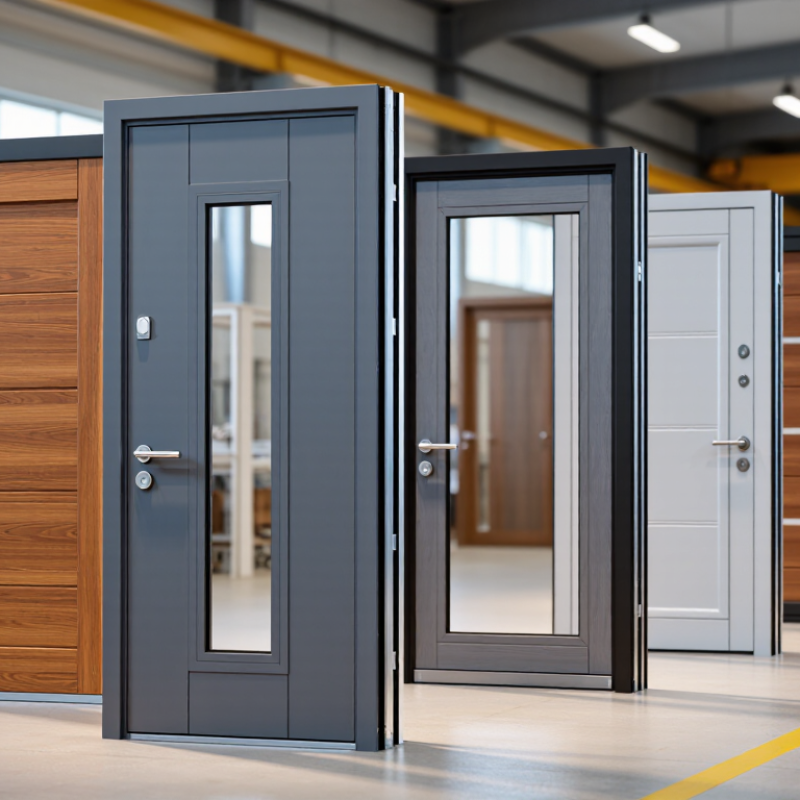
China’s entry door manufacturers work with steel, fiberglass, aluminum, solid wood, and engineered wood. The right choice depends on climate, security needs, appearance, and budget. Steel doors often pair galvanized sheet skins with insulated cores and reinforced lock areas. Fiberglass can reproduce wood grain and handle moisture, though surface quality varies. Aluminum suits modern designs and wide glazed openings; in colder locations, thermal breaks deserve close attention.
Manufacturing capabilities vary by factory. Some facilities cut, bend, weld, fill, assemble, and finish doors in-house, while others outsource parts of the process. Custom sizes, sidelights, glazing, thresholds, and hardware may be available. Ask for section drawings and confirm frame dimensions, hinge positions, seal details, and finish samples before production. Small details count. A sample corner can reveal more than a polished catalog image.
For global purchasing, request test documentation that matches the exact door configuration and intended use. Do not assume a report for one size or glass option covers every variation. Check how the door is packed for long-distance shipping, especially around exposed edges and glazing. There is no perfect specification for every project. A custom finish may extend lead times, and a stated capability may involve subcontractors, so clarify who handles each production stage.
When comparing Chinese entry door suppliers, begin with tests relevant to the destination market, not a generic claim of “international quality.” Request current reports for thermal transmittance, air leakage, water penetration, and wind-load performance. Required limits vary by climate and building code. Ask for evidence. Check that the tested size, frame, glazing, seals, and hardware match the quotation. A report for another assembly may offer little assurance.
Inspect section drawings and sample corners, not just finished photographs. Look for reinforced hinge zones, continuous weather seals, drainage paths, and corrosion-resistant fasteners. For steel or aluminum doors, ask how coating thickness and adhesion are checked. For timber doors, ask about moisture control and edge sealing. Details matter. Request hardware cycle-test data and clarify warranty exclusions, especially for finish wear and coastal exposure.
A capable supplier should trace each door to a production batch and provide inspection records, packing details, and installation tolerances. Check whether independent laboratory reports identify the same factory and product configuration. One imperfect point: factory audits cannot predict every shipment, and document dates are easy to overlook. Arrange a pre-shipment inspection on an actual order, then compare delivered frame dimensions and finish with approved samples.
| Comparison Dimension | What to Compare | Relevant Standard or Reference | Evidence to Request from the Supplier | Buyer Evaluation Tip |
|---|---|---|---|---|
| Product category and intended use | Confirm whether the product is an exterior entrance door, security door, fire door, or a combination designed for a specific application. | Requirements depend on the destination market and the door’s intended use. In China, GB 17565 addresses burglary-resistant security doors; GB 12955 addresses fire doors. | Product specification, intended-use statement, applicable test reports, and the exact model or configuration covered. | Do not treat a security classification or fire-door claim as proof that the door meets every local building-code requirement. |
| Security performance | Compare the tested resistance level, frame and leaf construction, lock and hardware configuration, and installation requirements. | GB 17565 is a Chinese reference for burglary-resistant security doors. The destination country may require its own security classification or testing scheme. | Full test report showing the tested door assembly, lockset, dimensions, construction, and classification—not only a product brochure. | Check that the supplied lock, frame, hinges, and installation method match the tested configuration. |
| Fire and smoke performance | Compare the fire-resistance classification, permitted dimensions, glazing options, seals, hardware, and any smoke-control performance required by the project. | GB 12955 applies to fire doors in China. Export projects may require destination-market fire-test evidence; EN 16034 covers fire-resisting and smoke-control characteristics for relevant doorsets. | Applicable fire-test and classification reports, certificate scope, installation instructions, and details of approved hardware and seals. | Fire performance applies to the tested assembly. Confirm that changes to size, glazing, hardware, or seals remain within the report’s scope. |
| Air, water, and wind performance | Compare air leakage, resistance to water penetration, and resistance to wind load for the complete door assembly. | EN 14351-1 is a product standard for external pedestrian doorsets in relevant European contexts. EN 12207, EN 12208, and EN 12210 classify air permeability, water tightness, and wind-load performance respectively. | Test reports with the test method, results, specimen dimensions, threshold details, and tested frame and seal configuration. | Compare results only when the test methods and specimen configurations are comparable; required performance varies by location and exposure. |
| Thermal and acoustic performance | Review the declared thermal transmittance, glazing specification where applicable, weather seals, threshold design, and sound-reduction test results. | Applicable energy and acoustic requirements vary by destination market, building type, and project specification. | Calculation or test documentation that identifies the complete doorset, including size, glazing, frame, threshold, and sealing details. | Ask whether the value applies to the complete door or only to an individual component; avoid comparing unlike test or calculation methods. |
| Materials and corrosion protection | Compare the specified door-leaf and frame materials, coating system, hardware materials, and suitability for the installation environment. | Material and coating requirements should be set against the project specification and the relevant destination-market requirements. | Material specifications, coating process details, inspection records, and corrosion-test reports where required by the project. | For coastal or humid locations, verify that the finish and hardware are suitable for the exposure and maintenance plan. |
| Quality management and production control | Assess documented inspection processes, traceability, control of purchased components, and handling of nonconforming products. | ISO 9001 specifies requirements for a quality management system; it is not a product-performance certification. | Current quality-management certificate and scope, production inspection records, traceability examples, and corrective-action procedures. | Check the certificate’s issuing body, validity, site, and scope. A management-system certificate does not replace product testing. |
| Test-report credibility and scope | Check whether reports cover the offered product and whether the test method and laboratory are appropriate for the target market. | ISO/IEC 17025 sets requirements for the competence of testing and calibration laboratories; accreditation scope matters. | Complete, verifiable reports identifying the laboratory, test date, standard and edition, sample description, results, and accreditation scope where applicable. | Verify reports with the issuing laboratory when needed, and confirm that the tested sample matches the proposed production specification. |
| Customization and configuration control | Compare available sizes, opening direction, finishes, glazing, hardware, thresholds, and the supplier’s process for approving changes. | Any market-specific performance requirement should be checked against the final configuration and applicable local regulations. | Approved drawings, bill of materials, finish samples, hardware schedule, and written confirmation of changes affecting tested performance. | Freeze the approved specification before production and require written approval for substitutions. |
| Packaging, shipping, and after-sales support | Review export packaging, handling instructions, spare-parts availability, installation guidance, warranty terms, and response arrangements. | Packaging, transport, warranty, and service expectations are generally established by the contract and destination-market requirements. | Packaging specification, pre-shipment inspection plan, installation instructions, warranty document, and spare-parts list. | Clarify responsibility for transport damage, installation-related issues, replacement parts, and claims before placing the order. |
Note: Standards and regulatory requirements can vary by destination market and may be updated. Confirm the current applicable editions, local acceptance rules, and project-specific requirements before ordering. A certificate or test report should be checked for its scope and relevance to the exact doorset being supplied.
Chinese entry-door manufacturers often build their expertise around specific materials and production methods. Some focus on steel security doors, using reinforced frames, multi-point locks, and weather-resistant coatings. Others specialize in aluminum doors with slim profiles and large glass panels for contemporary homes. Wood-door producers may offer carved details, veneer options, and custom finishes, but humidity control deserves close attention.
For global buyers, the right supplier depends on the project, not just the catalogue. Ask for section drawings, material specifications, and samples of the actual finish. Check that door dimensions, opening direction, hardware, and packaging match the installation plan. Small mismatches can create costly delays.
Some manufacturers also produce fire-rated or insulated models. Request relevant test documents and confirm that they apply to the exact door configuration and destination market. A test report for one size or hardware set may not cover another. Visit the factory when practical, or arrange a live production review. Look closely at welds, corner joints, surface consistency, and how doors are protected for shipping. A polished showroom can hide ordinary production limits. That matters. Factory capacity, communication, and quality checks should be assessed together, even when a lower quote looks attractive.
For global buyers comparing entry door manufacturers in China, verify the legal entity before discussing samples. Request the company’s registered name and Unified Social Credit Code, then check the details against China’s official enterprise information system. Make sure the exporter, factory, and certificate holder are clearly connected. Paper matters.
ISO’s ISO Survey 2022 counted 1,265,216 valid ISO 9001 certificates worldwide. That figure reflects quality-management certification, not proof that a particular door meets your market’s requirements. Ask for current certificates and confirm their scope and issuer. Then match each test report to the exact door model, dimensions, core, hardware, and finish being quoted. For laboratory reports, check whether the lab is accredited to ISO/IEC 17025 and whether the tested sample matches the production specification. A clean showroom is not proof. One weakness in this check is that documents can look complete while describing an older product. Request dated production photos, material records, and a pre-shipment inspection that checks door thickness, frame alignment, seals, and hardware operation. Minor differences matter. Keep the approved sample and specification on file, and record any changes in writing.
Use the certification audit cycle as one checkpoint when reviewing a manufacturer’s credentials. The timeline below shows typical ISO 9001 certification milestones; it is not a measure of door-product performance.
ISO/IEC 17021-1 requires the first surveillance audit to take place no later than 12 months after the certification decision. Subsequent surveillance is generally annual, while a three-year certification cycle is typical; confirm the dates with the certification body. Check that the certificate is current, issued by an appropriately accredited certification body, and covers the supplier’s relevant manufacturing site and activities. Separately, request product-specific test reports for the exact door model and configuration against standards applicable in your destination market.
Global buyers comparing entry door manufacturers in China should look beyond unit price. Request current specifications, finish samples, and test reports for the exact model. Door gauge, core material, seals, and hardware cutouts affect weight, performance, and installation. Confirm whether measurements describe the door leaf or the complete frame. Small details matter.
Tips: Send a marked-up opening drawing with swing direction, dimensions, and hardware locations. Ask for a sample label showing the selected finish and color code. Keep approvals in writing.
For customized orders, approve production drawings before manufacturing begins. Confirm tolerances, packaging, and protection for corners and glass. Ask for crate dimensions, gross weight, shipping terms, and a realistic production schedule. Lead time should start from approved drawings and samples, not an informal estimate. Finish color may still vary slightly between batches, so define acceptable limits. A pre-shipment inspection can help, but it works best with written acceptance criteria. Allow time for corrections; schedules are not always perfect.
Steel doors often use reinforced frames and multi-point locks. Aluminum models can have slim frames and broad glass panels. Wood doors may feature veneers or carved details. Humidity still matters.
Ask for section drawings, material specifications, and a sample of the actual finish. Check dimensions, opening direction, hardware, and packaging against the installation plan.
Request the registered company name and Unified Social Credit Code. Compare them with records in China’s official enterprise information system. Confirm how the exporter, factory, and certificate holder are connected.
No. It indicates a quality-management system, not that a particular door meets a buyer’s market requirements. Check the certificate’s date, scope, and issuer.
Match the report to the quoted model, dimensions, core, hardware, and finish. Confirm the laboratory’s accreditation and whether its tested sample matches production specifications. Paperwork can be outdated.
Check door thickness, frame alignment, seals, and hardware operation. Inspect welds, corner joints, surface consistency, and shipping protection. Small differences matter.
No. A showroom may hide production limits. When practical, visit the factory or arrange a live production review. Look closely at the work.
Keep the approved sample and specifications on file. Record changes in writing, and request dated production photos and material records. Checks can still miss things.
This guide helps global buyers understand the range of Entry Door options made in China, from different materials and designs to the manufacturing capabilities needed for residential and commercial projects. It explains how to compare suppliers by evaluating product construction, durability, security features, customization options, and relevant quality standards, so buyers can make informed decisions based on their project requirements.
The article also outlines practical steps for checking supplier credentials and assessing product quality before placing an order. It covers export sourcing considerations, including design specifications, packaging, communication, production schedules, and delivery planning. By approaching each stage with clear requirements and careful verification, buyers can identify suitable manufacturing partners and manage the sourcing process more effectively.