Choosing the right entrance door is more than comparing finishes and prices. It affects security, insulation, weather resistance, and the first impression of a property. For global buyers, these decisions become more complex because climates, building standards, installation practices, and supplier reliability vary widely.
This guide examines seven of the best Premium Aluminum Entry Door options for residential and commercial projects. Each selection is considered through practical criteria, including frame strength, thermal performance, hardware quality, glass safety, drainage design, and customization flexibility. A door exposed to coastal air needs different protection from one installed in a dry continental climate. Small details matter, such as sealed corners, adjustable hinges, and a threshold that prevents rainwater from entering.
Real-world performance depends on more than product specifications. A well-designed door can still underperform when measurements are inaccurate or installation is rushed. That is worth remembering. We also consider manufacturer experience, testing evidence, warranty clarity, replacement-part access, and communication across international orders. Certifications should be verified for the destination market rather than accepted without question.
No single model suits every buyer. Some projects prioritize narrow sightlines and modern glazing. Others need stronger thermal breaks, heavier security hardware, or easier maintenance. The seven doors below offer different strengths, but each deserves careful evaluation before purchase. Verify the details.ಿಸಿದ್ದಾರೆ
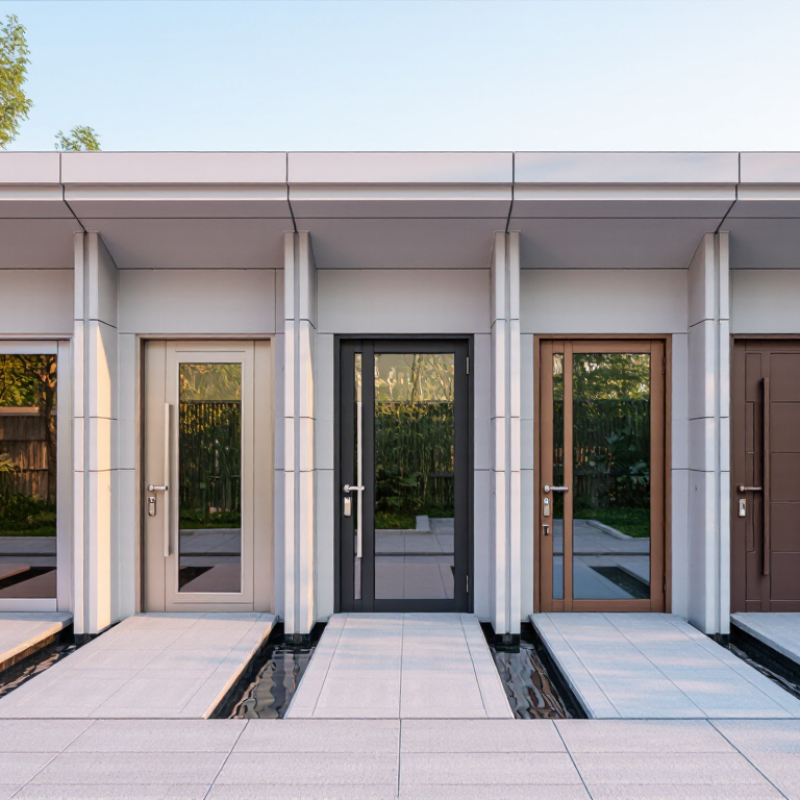
A premium aluminum entry door begins with stable engineering, not appearance alone. High-grade aluminum resists warping, corrosion, and seasonal movement. A thermal break separates the inner and outer metal surfaces, reducing heat transfer around the doorway. This detail matters in both cold winters and hot coastal climates.
Reliable doors also use multi-point locking, reinforced corners, and carefully fitted hinges. Weather seals should compress evenly, without visible gaps. Quality glass may include low-emissivity coating and laminated safety layers. In my experience, these small components often decide whether a door feels solid after years of daily use. The finish should resist fading, but even a strong coating can fail when preparation is poor. That part is sometimes overlooked.
7 Best Premium Aluminum Entry Doors for Global Buyers
Key Features Global Buyers Should Compare
Premium aluminum entry doors should be compared by performance, not appearance alone. The International Energy Agency reports that buildings consume about 30% of global final energy. Therefore, buyers should examine thermal breaks, frame depth, glazing, and tested U-values. Lower U-values generally indicate better insulation, although local calculation methods differ. A door designed for northern Europe may perform poorly in a hot, humid climate.
Air, water, and wind resistance also deserve careful attention. European buyers can review EN 12207, EN 12208, and EN 12210 classifications. North American projects often rely on NFRC-rated U-factor and solar heat gain coefficient data. Coastal or cyclone-prone regions need verified wind-load results, reinforced hinges, and secure multipoint locking. These details are less visible than a brushed finish, but they protect comfort and maintenance budgets. No door wins every climate.
Tips: Request complete test reports, not marketing claims. Check whether results cover the exact size, glass package, threshold, and hardware. Confirm drainage paths with a physical sample if possible. Small threshold decisions can create large water problems.
Finish durability matters too. Ask about coating standards, salt-spray testing, and color stability. The International Aluminium Institute states that recycled aluminum uses about 5% of the energy required for primary production. Recycled content can support sustainability goals, but buyers should verify the percentage and supply-chain documentation. I would not choose a door from thermal data alone; installation quality can quietly undermine excellent factory performance.
Premium aluminum entry doors vary in how they open, insulate, and shape an entrance. A standard hinged door suits many homes and is easy to maintain. A pivot door turns on floor and head-mounted pivots, creating a broad, dramatic opening; its weight and clearances need careful planning. A thermally broken door uses an insulating barrier between interior and exterior aluminum. This can reduce heat transfer, though performance depends on the full assembly, not the frame alone.
A glass-panel aluminum door brings daylight into a dark foyer. Look for suitable glazing and well-sealed joints, especially where wind-driven rain is common. A flush-panel door offers a clean, quiet surface and works well with restrained architecture. It can show dents more readily than a textured finish. A louvered aluminum door allows airflow and partial privacy, making it useful for sheltered entries, but it is not the best choice where strong weather sealing matters.
For wider entrances, double-leaf doors provide a generous opening and balanced proportions. They also need space for both leaves and reliable locking hardware. Oversized single doors create a similar sense of scale with fewer panels, but hinges and frames must be specified for the door’s weight. Small details matter. Before choosing, compare tested air and water performance, finish durability, threshold design, and local climate needs. A showroom sample can look convincing; real exposure may tell a less flattering story.
7 Best Premium Aluminum Entry Doors for Global Buyers
Performance, Security, and Climate Considerations
A premium aluminum entry door should be assessed as a complete system, not just a strong-looking slab. Check the frame, thermal break, seals, glazing, and installation details together. The U.S. Department of Energy estimates that windows account for 25–30% of heating and cooling energy use in homes; this figure is not specific to doors, but it shows why surrounding openings deserve careful attention. Compare tested U-factor and air-leakage ratings, and confirm the test applies to the actual door configuration. A low figure on a brochure may not describe the installed unit.
Security also depends on the full assembly. Look for a reinforced frame, secure hinge attachment, and a multi-point lock tested with the door. For performance comparisons, ask whether testing follows the North American Fenestration Standard, AAMA/WDMA/CSA 101. Coastal buyers should check corrosion-resistant finishes and hardware; regions with large temperature swings need stable seals and well-designed thermal breaks. Real weather is less tidy than a product chart.
Tips: Match the door’s tested water, air, and structural ratings to local exposure. Ask for the report, not just a sales claim. Inspect corner joints and the threshold in person; small gaps can matter. Also confirm who handles installation and adjustment, since even an excellent door can underperform when fitted poorly. I would not choose by thickness alone. That shortcut misses too much.
| Door Configuration | Best-Fit Application | Thermal Performance Considerations | Security Features to Specify | Climate and Weather Considerations | Buyer Verification |
|---|---|---|---|---|---|
| Thermally broken, insulated-panel door | Opaque or mostly opaque entrances where privacy and insulation are priorities. | Look for a continuous thermal break and insulated panel construction. Compare the whole-door U-factor; lower values indicate less heat transfer. | Specify a reinforced lock area, compatible multipoint locking, and a cylinder and hardware set suited to the local security requirements. | A useful option for both cold and hot climates when the frame, panel, seals, and threshold are designed as a complete system. | Request whole-door thermal data and air-leakage results for the exact size and configuration being purchased. |
| Thermally broken, double-glazed door | Homes and commercial buildings needing daylight with a balance of thermal performance and cost. | Specify insulated glazing with low-emissivity coating and gas fill where appropriate. Ask for the whole-door rating, not only the glass-center value. | Consider laminated or otherwise security-rated glazing where forced entry is a concern; confirm that the glass, beads, and frame are tested together. | Solar-control glazing can help limit unwanted heat gain in sunny climates. Glass selection should also account for orientation and glare. | Check glazing safety requirements for the intended location and request documented performance for the complete doorset. |
| Thermally broken, triple-glazed door | Cold climates, exposed elevations, or projects with demanding energy targets. | Three-pane glazing can improve insulation, but the complete result also depends on the frame, spacer, seals, and door size. | Use security-rated glass and compatible locking hardware if required; additional panes alone do not establish a security rating. | Check condensation resistance and interior surface temperatures for cold-weather use. Confirm that the heavier glazing is supported by suitable hinges. | Compare certified whole-door thermal data and verify that the tested configuration matches the proposed glazing and dimensions. |
| Large-format glazed aluminum door | Contemporary entrances where visibility and a broad glass area are important. | A large glazed area makes glass specifications especially important. Review whole-door U-factor and solar heat gain data where available. | Specify safety glazing as required by local codes and consider laminated glass for enhanced resistance to impact or forced entry. | For wind-exposed sites, confirm structural capacity and water resistance for the actual door dimensions and opening conditions. | Request tested air, water, and wind-pressure performance for a matching size, glazing build-up, and hardware arrangement. |
| Coastal-grade aluminum door | Coastal locations or other environments with frequent salt exposure. | Thermal performance depends on the frame break, panel or glazing, and seals; coastal finishes do not by themselves improve insulation. | Choose corrosion-resistant hardware and confirm that locks, hinges, fasteners, and finish are suitable for the exposure level. | Ask for finish and corrosion-resistance documentation. Drainage, compatible metals, and routine maintenance also matter near salt water. | Verify the specified coating or anodized finish against the project exposure and the supplier’s documented testing and maintenance guidance. |
| High-security multipoint-locking door | Entrances where resistance to forced entry is a key project requirement. | Thermal results still depend on the frame, core or glazing, and seals; security hardware should not compromise proper weather sealing. | Specify a tested doorset where possible, including the frame, hinges, cylinder, lock, keeps, and glazing. Check the applicable local security standard. | Confirm that the locking points engage reliably under the expected temperature range and that seals remain compressed without excessive operating force. | For European projects, check the relevant EN 1627 resistance classification; use the applicable local test or certification scheme in other markets. |
| Oversized pivot-style aluminum door | Architectural entrances where a wide or tall pivoting leaf is part of the design. | Large leaves can have different thermal and air-leakage behavior from standard hinged doors. Review data for the exact size and pivot arrangement. | Confirm secure locking at the meeting edge and suitable protection for pivot hardware. Specify access control separately if needed. | Wind loading, threshold drainage, and reliable sealing require particular attention on large leaves and exposed sites. | Check maximum tested dimensions, operating-force data, wind resistance, and warranty conditions for the proposed configuration. |
Comparison note: These are configuration types, not specific products or ranked test results. Performance varies by dimensions, glazing, hardware, installation, and local conditions. For North American projects, ask about applicable NFRC ratings and NAFS testing; for European projects, request relevant EN 12207 air-permeability, EN 12208 watertightness, and EN 12210 wind-resistance results. Confirm local code requirements before purchase.
For premium aluminum entry doors, measure the finished opening at the top, middle, and bottom, then use the smallest width and height. Check wall thickness, threshold depth, and floor level too; a few millimeters can complicate the fit. NFRC-certified product data reports whole-product U-factor, which measures heat transfer. For example, a hypothetical rating of 0.30 Btu/(h·ft²·°F) indicates less heat flow than 0.40. Compare like-for-like certified ratings, not glass-center figures alone.
Installation decides whether those ratings matter. Confirm the frame is square and plumb before fastening; uneven shims can twist the frame and cause latch drag. Seal the perimeter with compatible flashing and sealant, while keeping drainage paths open. DOE’s Energy Saver guidance recommends sealing air leaks around doors to reduce drafts and improve comfort. Still, sealant is not a substitute for correct flashing. That detail is easy to overlook.
Tips: Wipe aluminum frames with mild soap and water. Inspect weatherstripping, hinges, and threshold seals twice a year, especially after wet or windy seasons. Clear grit from the sill; it can wear the seal each time the door closes. Follow the door maker’s care instructions, since harsh cleaners may damage coatings. A small adjustment can help, but a door that keeps binding deserves a closer installation check.
The chart compares representative international door configurations by typical clear opening width and height. These dimensions are commonly used for residential and light-commercial projects; final sizes should be verified against local building codes, structural conditions, accessibility requirements, and the selected door system.
Common clear opening widths range from approximately 800 to 1,800 mm, while clear heights typically range from 2,000 to 2,400 mm. Oversized doors require additional structural review.
The frame should be installed plumb, level, square, and properly anchored. Continuous perimeter sealing, drainage paths, and compatible flashing are essential for air and water performance.
Clean aluminum surfaces and drainage channels at least twice a year, lubricate hinges and locks annually, and inspect weather seals after severe weather or heavy use.
Compare insulation, air and water resistance, wind-load results, security, finish durability, and installation requirements. Looks alone tell very little.
It generally means better insulation. Still, calculation methods differ, so compare ratings using the same regional standard.
Double-leaf doors create a broad opening, but both leaves need operating space and dependable locking hardware. Measure the entry carefully.
Not necessarily. Their broad opening can look striking, but door weight, pivot support, and floor clearance need careful planning.
Review the glazing specification and joint seals, especially in areas with wind-driven rain. A bright foyer is lovely; leaks are not.
Request complete test reports for the exact size, glass, threshold, and hardware. Check air, water, and wind ratings against local exposure.
No. Thermal breaks, seals, glazing, drainage, and installation all affect results. Thickness is an easy shortcut, but an incomplete one.
Check reinforced frames, secure hinge attachment, and multi-point locks tested with the door. The full assembly matters more than appearance.
Ask about coating standards, salt-spray tests, color stability, and verified recycled content. Request supply-chain records; a claim on paper is not proof.
Poor fitting can weaken a well-tested door’s performance. Confirm who installs and adjusts it, then inspect the threshold and corner joints. Small gaps matter.
Choosing a Premium Aluminum Entry Door requires more than comparing appearance and price. This guide explains what makes an aluminum entry door premium, including high-grade materials, precise engineering, thermal efficiency, weather resistance, durable finishes, and dependable security features. Global buyers will learn which specifications matter most, from insulation and hardware quality to corrosion protection and customization options.
The article also introduces seven types of premium aluminum entry doors suitable for different architectural styles, climates, and project needs. It highlights important considerations for performance and security, including wind, rain, heat, cold, and daily use. In addition, readers will find practical guidance on sizing, professional installation, threshold and frame selection, and long-term maintenance. With the right evaluation process, buyers can select a durable, attractive, and energy-conscious entry solution that performs reliably across diverse environments.