0%

Choosing a Luxury Aluminum Entry Door in 2026 requires more than admiring a dramatic finish or oversized handle. The decision should connect design, security, weather performance, and long-term maintenance. The U.S. Department of Energy reports that windows and doors can influence roughly 25% to 30% of residential heating and cooling energy use. That figure makes thermal breaks, insulated cores, weather seals, and low-conductivity thresholds practical priorities, not decorative upgrades.

Start with the building’s climate and entrance conditions. A coastal home may need enhanced corrosion resistance, while a cold-climate property needs careful attention to condensation control. Look for tested air infiltration, water penetration, structural performance, and thermal values. Standards from FGIA and certification guidance from NFRC can help compare products beyond showroom language. The 2024 Houzz & Home Study also shows continued homeowner investment in major renovations, but a larger budget does not automatically guarantee better engineering. Price can disguise weak installation.

Inspect the door in context. Imagine rain striking the sill, afternoon sun warming the dark panel, and daily traffic crossing the threshold. Ask whether the frame, hinges, lockset, glass, and drainage system were designed together. A beautiful door with poor flashing may age badly. That is an uncomfortable possibility. Even experienced buyers can overvalue appearance and undervalue installation quality. Request documented test results, finish warranties, hardware specifications, and installer references before choosing. In 2026, the strongest Luxury Aluminum Entry Door will balance refined architecture with measurable performance, credible documentation, and service that remains available after installation.
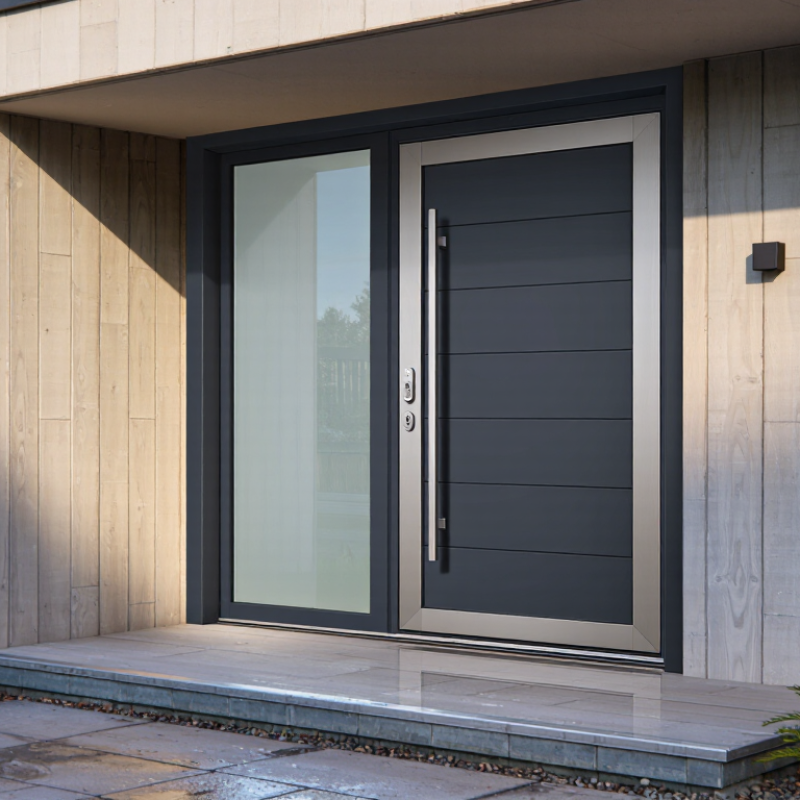
How to Choose a Luxury Aluminum Entry Door in 2026?

Define Your Luxury Aluminum Entry Door Requirements

Define your requirements before admiring finishes. Measure the opening, wall depth, threshold height, and available swing clearance. Record your climate zone, coastal exposure, rainfall, and security concerns. A door beside a windy shoreline needs different testing than one beneath a sheltered porch. Small oversights become expensive installation problems.

Ask for measurable performance, not vague luxury language. The U.S. Department of Energy reports that windows can represent 25–30% of residential heating and cooling energy use. A large glazed aluminum door deserves similar attention. Compare its U-factor, solar heat gain coefficient, air leakage, and visible transmittance through an NFRC label. Lower U-factor generally improves insulation, while SHGC should match local sun exposure. The 2022 AAMA/WDMA/CSA 101/I.S.2/A440 standard also provides performance classifications for air, water, structural, and operational testing. Request the actual test reports. A brochure is not evidence.

Then define the daily experience. Do you need a 900-millimeter clear opening, concealed hinges, acoustic glass, or a flush threshold? Check handle reach and the door’s weight after installation. Visit a completed project if possible. Touch the frame. Operate the lock repeatedly. I would not specify an oversized panel without confirming hinge capacity and installer competence. That choice can look dramatic, yet feel awkward every morning. Requirements should survive weather, maintenance, and real use—not only a showroom photograph.

Compare Aluminum Grades, Finishes, and Construction Methods

Choosing a luxury aluminum entry door in 2026 starts with the alloy, not the price tag. Common 6063 aluminum offers clean extrusion lines and a smooth architectural appearance. It suits most residential frames and detailed profiles. 6061 aluminum provides higher structural strength but can be less convenient for refined extrusion work. Ask for alloy documentation, not vague claims about “premium metal.”

Finish affects appearance, maintenance, and service life. Anodizing preserves the metal’s texture and resists peeling, while powder coating provides broader color choices and stronger visual uniformity. Dark finishes can absorb substantial heat in direct sunlight. Request coating thickness, surface preparation details, and accelerated weathering results. Coastal homes need extra attention to salt exposure and fastener compatibility. Small omissions become expensive later.

Construction quality often separates a luxury door from a heavy door. Look for thermally broken frames, insulated cores, accurate corner joints, and adjustable hinges rated for the panel weight. A continuous weather seal should compress evenly around the opening. Poor installation can defeat excellent materials. I have seen beautiful doors leak because the sill lacked proper drainage and flashing. That mistake is easy to miss during a showroom visit. Check the threshold height, hardware alignment, glass specification, and repair access before approving the final design. Ask how the frame tolerates building movement. No door stays perfect forever.

How to Choose a Luxury Aluminum Entry Door in 2026?

Compare aluminum grades, finishes, and construction methods before selecting a premium entry door system.

Aluminum Grades

6063-T5 is widely used for architectural extrusions because it offers good surface quality and formability. 6061-T6 provides substantially higher strength and is useful where heavier sections, larger openings, or increased structural stiffness are required.

Finishes

Anodizing creates an integral oxide layer and preserves the natural metallic appearance. Architectural powder coating offers a wider color range and textured options. For demanding exterior exposure, specify a finish tested to an appropriate architectural coating standard.

Construction Methods

A thermally broken frame reduces heat transfer compared with a continuous aluminum frame. Look for insulated cores, compression gaskets, drained sills, reinforced corner joints, and hardware engineered for the door’s size and weight.

Chart values show typical minimum tensile and yield strengths for common extrusion tempers, expressed in MPa. Actual properties vary with product standard, section thickness, and temper certification. Reference basis: commonly specified values in EN 755-2 and ASTM B221; verify the final profile documentation before purchase.

Evaluate Security Features, Thermal Performance, and Weather Resistance

How to Choose a Luxury Aluminum Entry Door in 2026?

A luxury aluminum entry door should feel solid before it looks impressive. Check the frame, hinges, lock body, and glass as one security system. A multipoint lock, reinforced strike plate, concealed hinges, and laminated glass can discourage forced entry. Ask for independent laboratory reports, not only showroom claims. Installation matters just as much. A poorly aligned door can weaken even excellent hardware. I have seen expensive doors lose performance because the threshold was fitted unevenly.

Thermal performance deserves careful attention. Look for a thermally broken aluminum frame, insulated panels, and low-emissivity glass. Request the complete U-value, not an isolated center-panel figure. Check air-leakage data, especially if your entrance faces strong wind. Weather resistance also depends on compression seals, drainage channels, and a raised, well-sealed threshold. Powder coating can protect the finish, but coastal air may require more frequent cleaning. Specifications help, but the building site can expose weaknesses.

Tips: Test the sample door by opening it slowly. Listen for rubbing or rattling. Ask how seals are replaced. Confirm the installer’s experience with local exposure, wind, and rain. Review the warranty in writing. Do not ignore maintenance access. A dramatic oversized door may also create heat loss, difficult operation, or structural stress. That trade-off is easy to miss.

How to Choose a Luxury Aluminum Entry Door in 2026? — Evaluate Security Features, Thermal Performance, and Weather Resistance
Evaluation Category Key Dimension Recommended 2026 Benchmark What to Verify Before Purchase Why It Matters
Security Locking system Multipoint locking with at least three locking points; a deadbolt and reinforced strike area are preferred. Confirm the locking system is designed for the door height and includes adjustable, corrosion-resistant hardware. Multiple engagement points distribute impact loads and help reduce forced-entry vulnerabilities around the latch side.
Security Lock quality Use a lockset tested to a recognized standard, such as ANSI/BHMA Grade 1 where applicable, or an equivalent regional standard. Request the test classification and confirm that the cylinder, escutcheon, strike, and keys are included in the tested assembly. Lock performance depends on the complete hardware assembly rather than the cylinder alone.
Security Glazing protection Laminated safety glass, preferably with a security-oriented interlayer, for sidelights and glazed door panels. Check the glass construction, thickness, impact classification where required, and whether the glass is retained from the secure side. Laminated glass remains bonded after breakage and is more difficult to penetrate than ordinary annealed glass.
Security Hinge and frame reinforcement Concealed or security hinges, reinforced hinge-side connections, and a mechanically anchored frame. Verify hinge adjustment capacity, anti-lift protection, anchor spacing, and installation into structural framing. A strong door leaf cannot provide effective security if the frame, hinges, or anchors are weak.
Thermal Performance Thermal break A continuous polyamide or equivalent thermal barrier separating the interior and exterior aluminum sections. Look for a documented thermal-break design across the frame, threshold, sash, and panel perimeter. Thermal breaks reduce conductive heat flow and help limit interior surface condensation.
Thermal Performance Whole-door U-factor Target approximately ≤ 0.30 Btu/h·ft²·°F (≈ 1.70 W/m²·K) for a well-insulated residential entry assembly, subject to climate and local code. Request a whole-door or NFRC-style rating; do not rely only on the center-of-glass or panel value. Lower U-factor indicates less heat transfer through the complete installed door assembly.
Thermal Performance Glazing configuration Low-emissivity double glazing with an inert-gas fill; triple glazing may be appropriate in colder climates. Check the glass U-factor, solar heat gain coefficient, spacer type, gas-fill declaration, and visible-light transmission. Glazing can represent a significant portion of the entry assembly and strongly affects comfort and energy use.
Thermal Performance Weather seals Continuous compression gaskets at the perimeter, a sealed sill, and a replaceable sweep or adjustable drop seal. Inspect gasket continuity at corners and confirm that seals remain compressed when the door is latched. Air leakage around the perimeter can undermine the performance of an otherwise efficient door.
Weather Resistance Air leakage Prefer a tested air-leakage result of ≤ 0.30 cfm/ft² at 1.57 psf, or the applicable regional equivalent. Ask for test results based on ASTM E283, EN 1023-1, or another recognized standard appropriate to the market. Lower air leakage improves comfort, reduces drafts, and limits moisture movement through the assembly.
Weather Resistance Water penetration A tested water-penetration rating of at least 15 psf is a useful baseline for many residential applications; exposed locations may require more. Confirm the pressure rating, test standard, sill design, drainage path, and whether the rating applies to the exact door size. Water performance depends on the door, frame, sill, seals, drainage, and installation—not on the aluminum finish alone.
Weather Resistance Structural performance Choose a door tested to the applicable NAFS, EN, or local structural standard for the project’s wind exposure and dimensions. Review the product’s size limits, design pressure, operating-cycle results, and deflection data. Large luxury doors experience greater wind and hardware loads, especially when they include wide glass panels.
Weather Resistance Aluminum finish For architectural powder coating, look for a documented high-performance specification such as AAMA 2605 or an equivalent regional requirement. Verify coating thickness, color consistency, gloss level, pretreatment, warranty terms, and cleaning instructions. A properly prepared and coated surface provides better resistance to fading, chalking, and corrosion.
Weather Resistance Drainage and sill design A thermally improved sill with positive drainage, weep paths, end dams, and an exterior pan or flashing strategy. Confirm that drainage openings remain accessible and that the sill is compatible with the building’s waterproofing system. Correct drainage helps prevent trapped water, interior leakage, and deterioration around the threshold.
Installation Frame anchoring Mechanical anchoring into structural framing, with shims, perimeter air sealing, sill flashing, and compatible sealants. Require an installation method statement and confirm that the installer follows the door manufacturer’s tested details. Field installation can determine whether the tested laboratory performance is achieved in the building.
Long-Term Value Maintenance and serviceability Replaceable gaskets, adjustable hinges, serviceable lock hardware, accessible drainage paths, and documented maintenance intervals. Ask about replacement-part availability, refinishing limitations, lubrication requirements, and inspection frequency. Serviceable components help preserve security, sealing, operation, and appearance over the door’s life.
Selection note: Performance values are practical specification targets and should be confirmed against the exact door size, glazing configuration, climate zone, exposure, local building code, and independently tested assembly. Laboratory ratings do not replace correct structural anchoring, flashing, drainage, and air-sealing during installation.

Select Smart Access Systems and Custom Design Options

How to Choose a Luxury Aluminum Entry Door in 2026?

A luxury aluminum entry door should make access simple, not turn your hallway into a control panel. Choose a system with keypad, mobile, and physical key access. Redundancy matters when batteries fail or phones disappear. The National Institute of Standards and Technology recommends strong, unique authentication and careful credential management. Therefore, avoid shared codes for contractors or frequent visitors. Use temporary credentials with automatic expiration.

Custom design should support daily movement. Consider a thermally broken aluminum frame, insulated glass, concealed hinges, and a low-threshold sill. The U.S. Department of Energy identifies doors and windows as important parts of a home's energy performance, while NFRC certification helps compare tested thermal values. Ask for documented U-factor and air-leakage results. Numbers beat showroom confidence.

Tips: Test the lock with wet hands and poor lighting. Check whether the keypad remains readable at night. Confirm local installation support and emergency access procedures. Parks Associates' 2024 smart-home research shows that connected devices are increasingly common in American households, but adoption does not guarantee good usability. I would not select the most automated option automatically. A quiet motor, clear feedback, and manual backup may feel more luxurious. One compromise remains: custom hardware can delay replacement parts. That deserves honest discussion before ordering.

Verify Installation Standards, Warranty Coverage, and Long-Term Value

How to Choose a Luxury Aluminum Entry Door in 2026?

A luxury aluminum entry door should meet local building standards before it impresses visitors. Ask for documented air, water, structural, and thermal performance tests. Confirm the required wind-load rating for your region. Coastal homes may need enhanced corrosion protection and stronger fastening details. Installation matters just as much as the door itself. Check whether the installer is trained, insured, and experienced with large, heavy panels. Request a written installation scope, including sill flashing, drainage, shimming, and perimeter sealing.

Read the warranty carefully, not just the headline coverage period. It should identify covered materials, finishes, hardware, glass, labor, and transfer conditions. Ask who handles service if the installer closes or changes ownership. Keep invoices, photographs, and maintenance records in one file. Small omissions can become expensive later. A warranty may exclude problems caused by movement, poor drainage, incorrect cleaning, or unauthorized modifications.

Long-term value depends on daily performance, not showroom appearance. Test the lock, hinges, and handle before approval. The door should close evenly without excessive force or rubbing. Inspect the threshold after heavy rain, if possible. Review finish-care instructions and expected replacement costs for seals and hardware. I have seen buyers overpay for decorative details while overlooking poor water management. That is an easy mistake to repeat. Sometimes a simpler door, installed precisely, delivers greater comfort and fewer service calls over ten years.

FAQS

Which aluminum alloy suits a luxury entry door?

6063 aluminum supports clean extrusion lines and detailed residential profiles. 6061 offers greater structural strength. Ask for alloy documentation. “Premium metal” is too vague.

How do anodizing and powder coating differ?

Anodizing preserves the metal’s natural texture and resists peeling. Powder coating offers more colors and consistent coverage. Dark colors absorb strong sunlight and heat. The choice is not purely visual.

What construction details should I inspect?

Look for thermally broken frames, insulated panels, accurate corners, and adjustable hinges. The weather seal should compress evenly. Check drainage and flashing carefully. A beautiful door can still leak.

Which security features are worth checking?

Consider multipoint locking, reinforced strike plates, concealed hinges, and laminated glass. Review independent test reports. Do not judge security by weight alone. Alignment matters.

How can I evaluate thermal performance?

Request the complete door U-value, not only the center-panel figure. Check air-leakage results and low-emissivity glass options. Oversized doors may increase heat loss. Bigger is not automatically better.

What helps an aluminum door resist rain and coastal exposure?

Inspect compression seals, drainage channels, threshold height, and sill flashing. Coastal air may require enhanced corrosion protection and regular cleaning. Fastener compatibility also matters. Salt is persistent.

What should the installation agreement include?

Request written details for shimming, flashing, drainage, sealing, and structural fastening. Confirm the installer’s experience with heavy panels and local weather. Poor installation can weaken excellent materials. I might underestimate this risk too.

What should a useful warranty cover?

Check coverage for materials, finishes, hardware, glass, labor, and transfer conditions. Ask who provides service if ownership changes. Keep invoices, photos, and maintenance records together. Headlines can mislead.

Conclusion

Choosing a Luxury Aluminum Entry Door in 2026 begins with clearly defining your priorities, including dimensions, architectural style, budget, insulation needs, and daily use. Compare aluminum grades, surface finishes, and construction methods to identify a door that offers lasting strength, refined appearance, and resistance to corrosion, fading, and deformation. Pay close attention to thermal breaks, weather seals, multi-point locking systems, reinforced frames, and impact-resistant components to support comfort, security, and dependable performance in changing climates.

Modern entry doors can also integrate smart access options such as keyless entry, app-based control, video monitoring, and temporary access codes. Custom colors, glass designs, hardware, and panel configurations allow the door to complement your home’s character. Before purchasing, verify professional installation standards, accurate measurements, drainage details, and applicable warranty coverage. A well-selected Luxury Aluminum Entry Door should balance design, protection, energy efficiency, maintenance requirements, and long-term value rather than focusing only on initial appearance or cost.

Ethan

Ethan

Ethan is a professional marketing specialist who combines a strong understanding of the company’s products with a clear, customer-focused approach to communication. Through his regular articles on the company website, he explains product features, practical applications, and industry developments......