0%

Choosing an Aluminium Entrance Door is more than a style decision. It affects security, comfort, maintenance, and the first impression of your home.

Neil Ginger, CEO of Origin Global, has said, “A front door should combine performance, personality, and everyday practicality.” That principle explains aluminium’s growing popularity. Aluminium frames can support wide glass panels without appearing heavy. They also resist warping, swelling, and corrosion better than many traditional materials. This matters when rain, frost, and strong sunlight reach the entrance every day.

Picture a busy morning. A child pulls the handle, muddy shoes cross the threshold, and cold air presses against the frame. A properly designed Aluminium Entrance Door should close smoothly and keep the hallway comfortable. Thermally broken profiles can reduce heat transfer, while quality seals help limit draughts and outside noise. Secure multi-point locks and laminated glass can provide additional protection when correctly specified and installed.

Looks matter, too. Slim sightlines create a cleaner façade. Powder-coated finishes offer many colour choices and usually need little maintenance. A quick wipe may be enough.

But aluminium is not automatically perfect. Poor installation can cause leaks, alignment problems, or disappointing insulation. Hardware quality varies. Some low-cost systems may feel less solid than expected. That is easy to overlook.

The sensible choice is evidence. Check thermal values, security testing, warranties, drainage details, and installer experience. Ask to see a finished project before ordering. A beautiful door is useful only when it performs reliably for years.
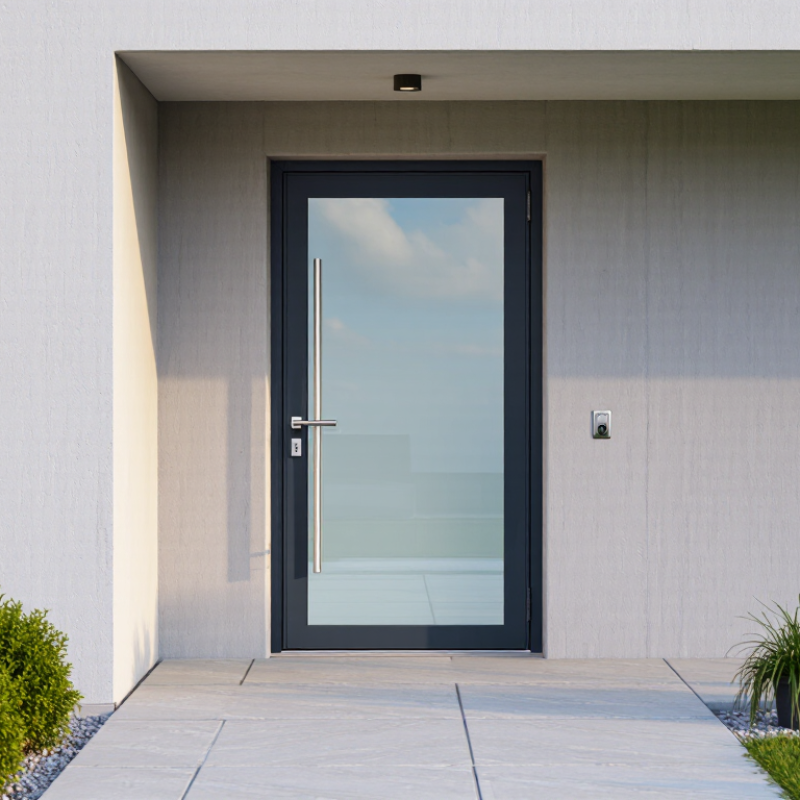
Why Choose an Aluminium Entrance Door for Your Home?

What Is an Aluminium Entrance Door?

An aluminium entrance door is a front door built from aluminium profiles and a glazed, solid, or decorative panel. The frame and sash are cut, joined, and fitted with seals, hinges, and locking hardware. Unlike a simple metal sheet, a quality system usually includes a thermal break. This insulating section separates the inner and outer aluminium surfaces, reducing heat transfer and condensation around the frame. Aluminium is light, rigid, and resistant to rot. That makes it useful for wide door leaves and busy household entrances.

From a practical installation viewpoint, accurate measurements matter more than many homeowners expect. A small error can create uneven gaps, draughts, or difficult locking. The surrounding wall must also be checked for movement and moisture. Powder-coated or anodised finishes can protect the surface and provide colour, but they do not hide poor fitting. Fit matters too. Good installers check the threshold, drainage path, seal compression, and door alignment before handover. The lock should operate smoothly without force.

An aluminium entrance door is not maintenance-free. Seals may age, hinges can need adjustment, and dark colours may feel warmer in strong sun. Thermal performance also depends on the glass, panel, threshold, and installation—not aluminium alone. I would ask for tested U-values, air-tightness data, security specifications, and suitable local compliance documents. Some impressive-looking doors disappoint when these details are overlooked. That is an uncomfortable point, but it helps homeowners compare complete door systems rather than attractive finishes.

Why Choose an Aluminium Entrance Door for Your Home?

What Is an Aluminium Entrance Door?

An aluminium entrance door is an exterior door made with lightweight, corrosion-resistant aluminium profiles. Modern systems commonly use insulated panels, weather seals and thermal breaks to improve energy efficiency, security and comfort.

The chart shows approximate thermal conductivity at room temperature, measured in W/m·K. Aluminium conducts heat more readily than wood, uPVC and steel, which is why quality aluminium entrance doors use thermal-break technology. Actual door insulation depends on the complete door design, glazing, seals and installation.

How Aluminium Entrance Doors Are Designed and Manufactured

Why Choose an Aluminium Entrance Door for Your Home?

Aluminium entrance doors begin with careful profile design. Engineers model the frame for strength, drainage, thermal movement, and secure hardware. A thermal break separates the outer and inner aluminium sections. This reduces heat transfer through the frame. Designers then test corner joints, hinges, locks, and weather seals under repeated use.

Manufacturing starts with aluminium billets, usually shaped through precision extrusion. The profiles are cut, drilled, and joined into a rigid frame. Powder coating or anodising adds colour and surface protection. Glass panels are fitted with gaskets, spacers, and controlled pressure. The International Aluminium Institute reports that recycled aluminium requires about 5% of the energy used for primary aluminium production. That figure supports circular design, although recycling systems still vary by region. Factory accuracy matters. A small cutting error can create visible gaps at the threshold.

Tips: Ask for documented U-values, air-tightness testing, and corrosion resistance data. Check the threshold height before installation. Measure twice. Also, inspect drainage channels after heavy rain. They are easy to overlook. A low-maintenance door still needs adjustment and cleaning. Perfect performance is not automatic. Even well-designed systems can fail when installation is rushed. Manufacturers should provide test reports, maintenance guidance, and clear material specifications. E-E-A-T depends on evidence, not polished promises.

Key Benefits of Aluminium Entrance Doors for Homes

Why Choose an Aluminium Entrance Door for Your Home?

Key Benefits of Aluminium Entrance Doors for Homes

An aluminium entrance door offers a strong combination of durability, security, and clean design. Installers often choose aluminium because it resists warping, swelling, and cracking better than many traditional materials. The frame stays stable through hot summers, cold winters, and frequent daily use. That matters.

A well-made door with thermal breaks can reduce heat transfer through the frame. Combined with quality glazing and weather seals, it may help maintain a steadier indoor temperature. Secure multi-point locks and a rigid frame can also improve resistance to forced entry. However, aluminium is not magic. Poor installation, weak hinges, or badly fitted seals can reduce these benefits quickly. The door itself is only part of the system.

Maintenance is usually simple. Wipe the frame with mild soapy water, clear the drainage channels, and check the seals occasionally. Modern powder-coated finishes can keep their colour for years, although harsh cleaning products may cause damage. Slim frames allow more daylight into a hallway, while different finishes can suit brick, stone, or rendered walls. There is a practical trade-off: aluminium doors can cost more initially than basic alternatives. Yet their long service life and limited upkeep may make the investment reasonable for many homes. A careful survey remains essential, especially where the opening is old, uneven, or exposed to strong coastal weather.

How to Choose the Right Aluminium Entrance Door

Choosing the right aluminium entrance door starts with performance, not appearance. Aluminium is strong, stable, and resistant to warping. However, an uninsulated frame can still feel cold beside the handle. Look for a thermally broken profile, low U-value, and tested air-leakage performance. The NFRC explains that U-factor measures heat transfer, while SHGC shows how much solar heat enters through glazing. These figures matter more than a glossy finish.

Energy efficiency deserves attention. The International Energy Agency reported that buildings used about 30% of global final energy in 2022. A well-specified door cannot solve every household energy problem, but it can reduce drafts around a busy entrance. Check the complete door assembly, including the frame, glass, threshold, seals, and installation method. A high-performing panel may underperform if the threshold is poorly sealed. This is an easy detail to miss.

Tips: Compare certified U-values, not vague claims. Choose double or triple glazing for exposed entrances. Test the lock, hinges, and closing action in person. In windy or coastal areas, ask about drainage, corrosion resistance, and finish durability. Measure the opening twice. I would also inspect the installer’s previous work, because fitting quality often decides the final result. Good-looking doors sometimes disappoint after winter arrives.

Why Choose an Aluminium Entrance Door for Your Home? - How to Choose the Right Aluminium Entrance Door

Indicative selection data for residential aluminium entrance doors. Always confirm the tested performance of the complete door set and check local building regulations.
Selection Criterion Recommended Data or Target Why It Matters Questions to Ask the Supplier
Thermal performance Look for a low whole-door U-value, commonly around 0.8–1.6 W/m²K for a well-insulated modern entrance door. A lower U-value means less heat transfer through the door and may improve indoor comfort and energy efficiency. Is the stated U-value for the complete door, including the frame, glazing and hardware?
Thermal break Choose a frame with a polyamide or equivalent thermal-break system separating the inner and outer aluminium sections. Aluminium conducts heat efficiently; a thermal break reduces conductive heat flow and helps limit internal condensation. What thermal-break material and profile depth are used, and what is the tested frame performance?
Weather resistance Review tested air permeability, watertightness and wind-load classifications under standards such as EN 12207, EN 12208 and EN 12210. Suitable classifications help the door resist draughts, wind-driven rain and pressure changes. What are the exact test classifications for the proposed size and configuration?
Security level For many homes, consider a door tested to at least RC2 under EN 1627; higher-risk locations may require a higher class. Security classification evaluates the resistance of the complete door assembly, not just the lock or cylinder. Has the complete door been tested, including the frame, hinges, locks, glazing and fixing method?
Glazing safety Use safety glass where required, such as toughened or laminated glass, with low-emissivity double glazing commonly offering better insulation than single glazing. Safety glazing reduces injury risk if the glass breaks, while insulated glazing can improve thermal and acoustic performance. What glass type, thickness, safety classification and spacer system are included?
Durability and corrosion resistance Specify a finish suitable for the exposure conditions, with a documented coating specification and pretreatment process. Correct pretreatment and coating help protect aluminium from weathering, pollutants and corrosion, especially in coastal areas. What coating standard, warranty conditions and maintenance requirements apply to the chosen finish?
Hardware and locking Look for adjustable hinges, a multi-point locking system and hardware rated for the door’s weight and usage frequency. Appropriate hardware supports smooth operation, reliable sealing and long-term alignment. Can the hinges be adjusted after installation, and are replacement components available?
Threshold and accessibility Choose a threshold height and profile that balance weather protection with the access requirements of the household. A lower or flush threshold can improve accessibility, but it must still provide adequate drainage and weather sealing. What is the finished threshold height, drainage arrangement and compliance with local accessibility rules?
Door size and structural suitability Confirm the maximum tested dimensions, panel weight, opening direction and fixing requirements before ordering. Large or heavy doors place greater demands on hinges, frames, fixings and surrounding wall construction. Has the installation been surveyed, and are the proposed dimensions within the tested limits?
Maintenance requirements Plan regular cleaning with mild detergent and periodic inspection of seals, drainage paths, hinges and locking points. Routine care helps preserve appearance, drainage performance, weather sealing and smooth operation. Which cleaning products should be avoided, and how often should the hardware and seals be serviced?
Environmental considerations Aluminium is widely recyclable; ask about recycled content, responsible sourcing and end-of-life recycling arrangements. Material sourcing and recycling can affect the door’s overall environmental impact. Is recycled aluminium used, and can the frame and components be separated for recycling?
Installation quality Use a competent installer and require the frame to be level, plumb, square, securely fixed and properly sealed to the building. Even a high-performing door can lose efficiency and weather resistance if it is poorly measured or installed. What installation method, warranty coverage and post-installation adjustment service are provided?

Installation, Maintenance, and Long-Term Performance

An aluminium entrance door performs well when installation is treated as a building-envelope task. The frame must sit square, with continuous packers beneath the threshold. A small gap can invite draughts, rain, and hinge movement. ENERGY STAR’s Version 7.0 specification uses climate-specific U-factor and solar heat-gain limits for doors and windows. Thermal breaks matter because uninsulated aluminium transfers heat quickly.

On site, installers should check the opening before ordering. Brickwork is rarely perfect. They should seal the perimeter in layers, not rely on one thick bead of foam. The threshold also needs support and a slight fall outside. The U.S. Department of Energy estimates that windows can represent 25–30% of household heating and cooling energy use. A poorly sealed glazed door can undermine otherwise careful insulation work.

Maintenance is simple, but not optional. Clean the frame with mild soap every few months, especially near coastal air. Keep drainage slots open. Lubricate hinges and locks according to the hardware instructions, then inspect gaskets for flattening. High-performance powder coatings are assessed under AAMA 2605 requirements, including accelerated weathering and South Florida exposure tests. That is useful evidence, not a promise of zero fading. In practice, dark finishes may warm noticeably in direct sun, and seals eventually age. I would not ignore that weakness. A yearly inspection can catch it before a rainy evening proves the point.

FAQS

What is an aluminium entrance door?

It combines aluminium profiles with glass, a solid panel, or a decorative panel. The frame usually includes seals, hinges, and locking hardware. A thermal break can reduce heat transfer and condensation.

Why is aluminium suitable for entrance doors?

Aluminium is light, rigid, and resistant to rot. It supports wide door leaves and frequent daily use. That makes it practical for busy household entrances.

How is an aluminium entrance door manufactured?

Aluminium billets are shaped into precise profiles through extrusion. The profiles are cut, drilled, and joined into a stable frame. Glass panels receive gaskets, spacers, and controlled pressure.

What should be checked before installation?

Measure the opening carefully, preferably twice. Installers should inspect wall movement, moisture, threshold height, and drainage. Small errors can create draughts or difficult locking.

Can an aluminium entrance door improve energy efficiency?

A thermal break can reduce heat transfer through the frame. Glass, panels, seals, thresholds, and installation also affect performance. Aluminium alone does not guarantee a warm entrance.

Are aluminium entrance doors secure?

A rigid frame and suitable multi-point locks can improve resistance to unwanted access. Hinges, cylinders, panels, and installation quality also matter. Security is a complete system, not one feature.

How should an aluminium entrance door be maintained?

Wipe the frame with mild soapy water. Clear drainage channels after heavy rain. Check seals and hinges occasionally, because adjustment may become necessary.

Do aluminium entrance doors need much maintenance?

They usually need less upkeep than many traditional materials. Powder-coated or anodised surfaces can retain colour for years. Still, they are not maintenance-free. That expectation is slightly unrealistic.

Can aluminium entrance doors suit different home styles?

Slim frames can bring more daylight into a hallway. Different surface colours can complement brick, stone, or rendered walls. Dark finishes may feel warmer under strong sunlight.

What documents should buyers request?

Ask for tested U-values, air-tightness results, security specifications, and corrosion data. Request maintenance guidance and local compliance documents too. An attractive finish is not enough evidence.

Conclusion

An Aluminium Entrance Door is a modern home entry solution made from strong, lightweight aluminium profiles, usually combined with insulated panels, secure glazing, hinges, locks, and weather-resistant finishes. Its design and manufacturing process focuses on precise measurements, durable construction, thermal performance, and a balanced appearance that suits both contemporary and traditional homes. Aluminium can be shaped and finished in various ways, allowing homeowners to choose different colors, textures, glazing options, panel styles, and hardware.

The main benefits include excellent strength, resistance to corrosion and warping, low maintenance requirements, improved security, and reliable performance in changing weather conditions. When choosing an Aluminium Entrance Door, homeowners should consider size, insulation, glass type, security features, opening direction, design, and budget. Professional installation is essential for a proper seal and smooth operation. With occasional cleaning, hardware checks, and timely attention to minor wear, an aluminium entrance door can maintain its appearance, energy efficiency, and dependable performance for many years.

Elowen

Elowen

Elowen is a professional marketing specialist dedicated to helping businesses understand products, industries, and customer needs through clear, practical, and insight-driven communication. With a strong understanding of the company’s product portfolio, market positioning, and service standards,......